Validation
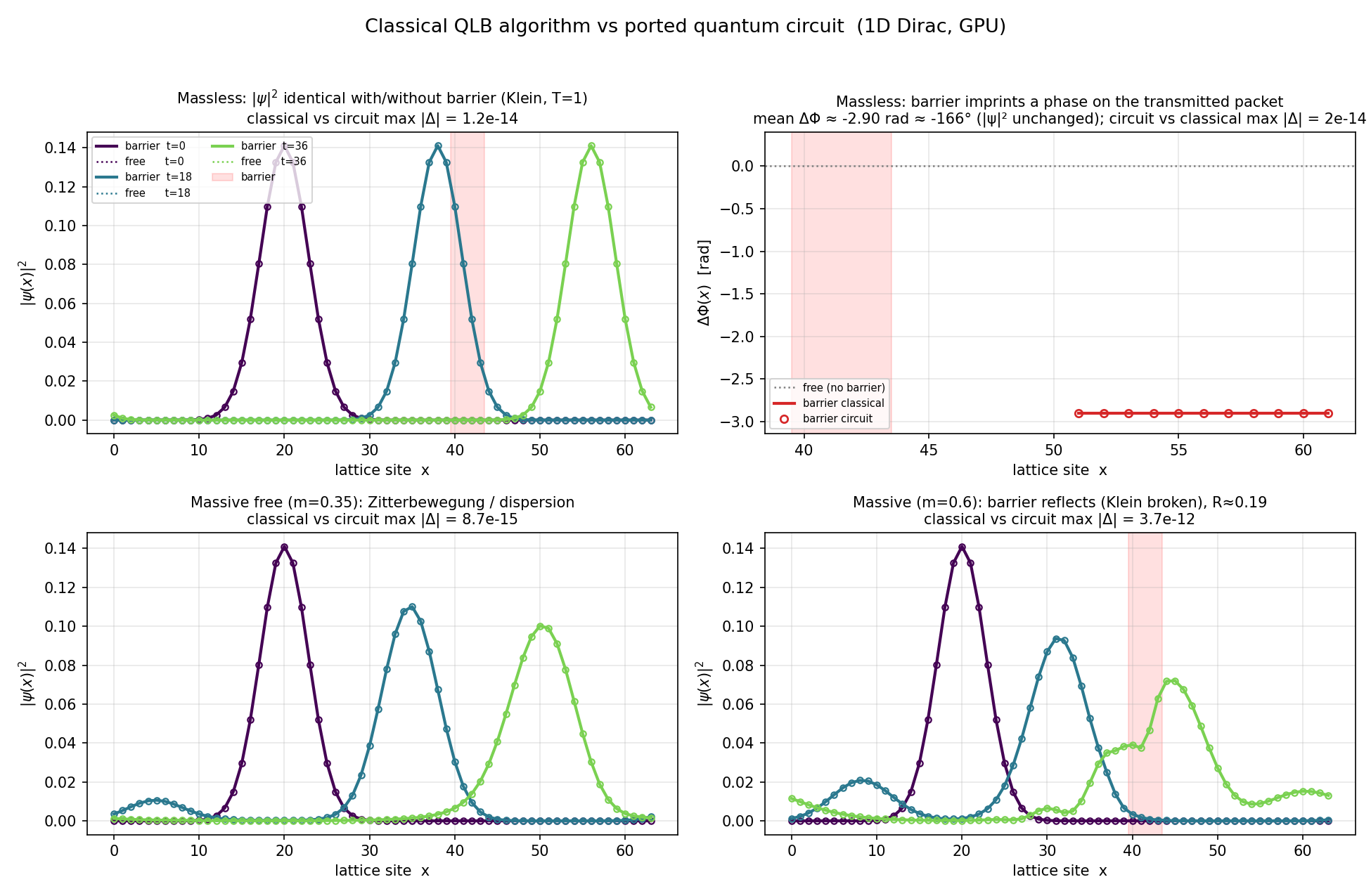
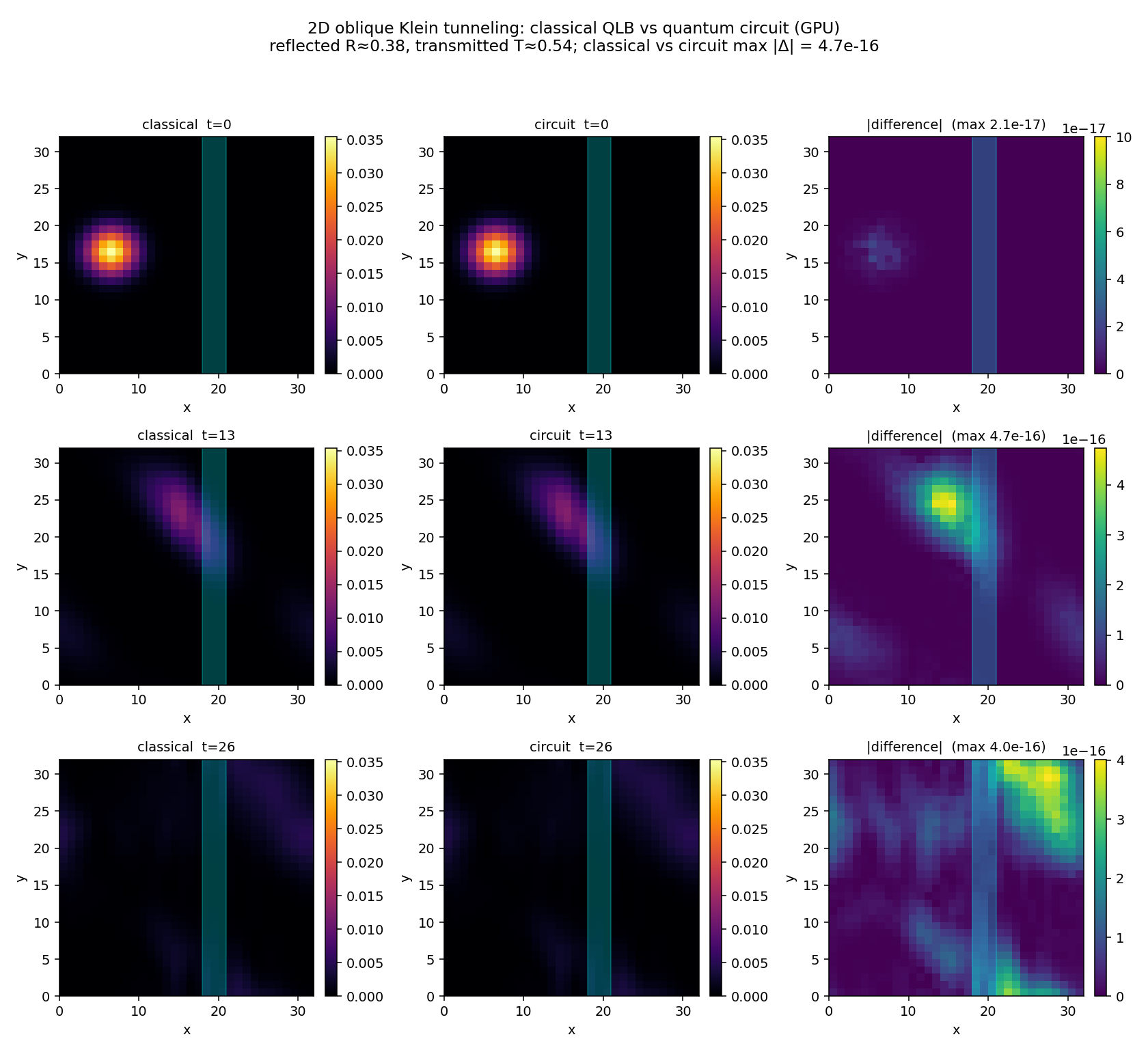
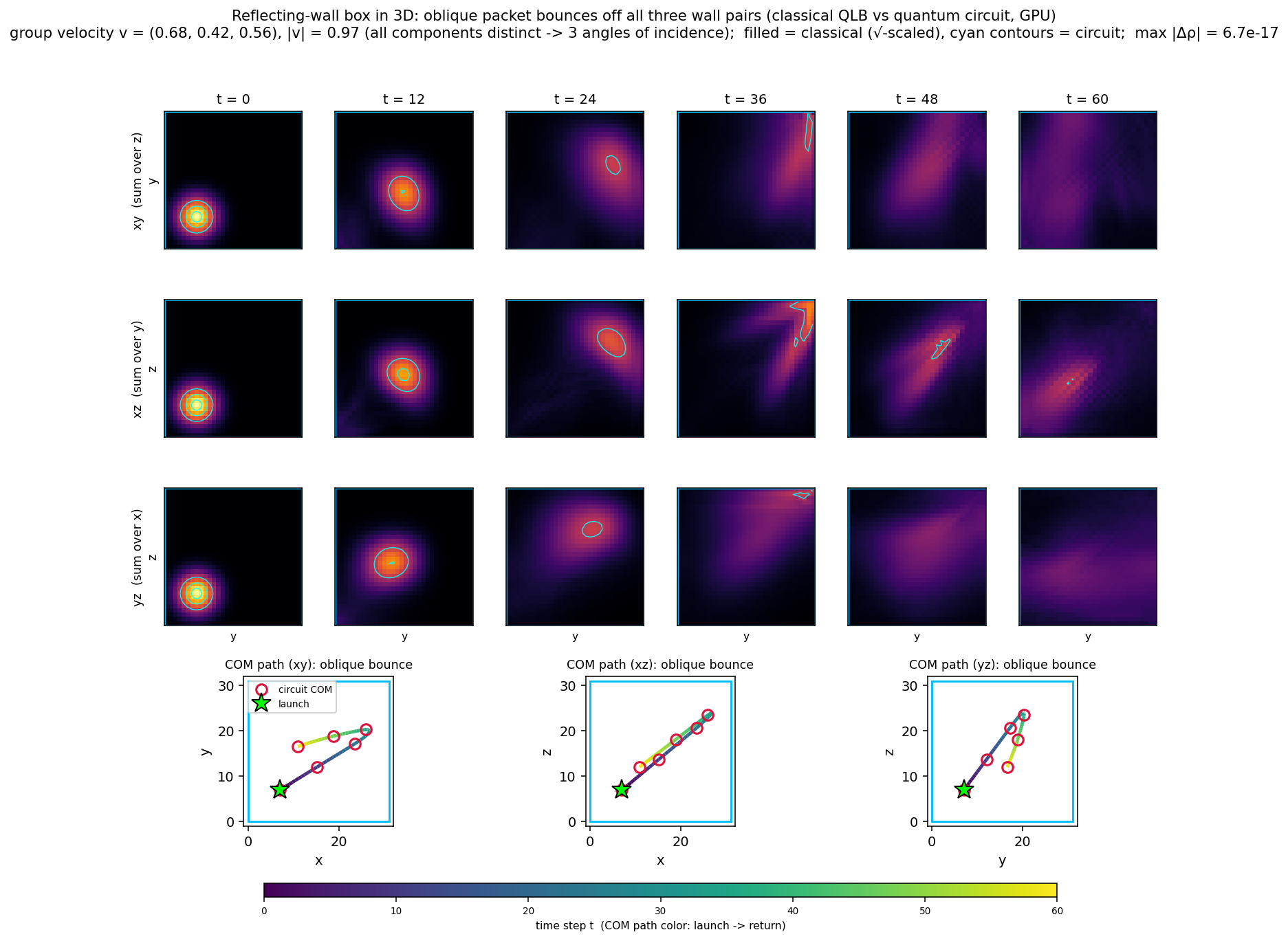
On a state-vector emulator, the ported circuits reproduce the classical QLB solver to machine precision. The figure of merit is the maximum absolute density deviation \(\max|\Delta\rho|\) over all sites and recorded times; the state fidelity is 1 to twelve digits throughout.
Test |
Lattice (qubits) |
Physics |
\(\max|\Delta\rho|\) |
|---|---|---|---|
1D free / barrier / phase |
\(2^6\) line (8) |
massless & massive |
\(3.7\times10^{-12}\) |
2D oblique Klein |
\(2^5\times2^5\) (12) |
massless barrier |
\(4.7\times10^{-16}\) |
3D diagonal mover |
\(2^4\times2^4\times2^4\) (14) |
massless free |
\(1.0\times10^{-17}\) |
3D reflecting box |
\(2^5\times2^5\times2^5\) (17) |
massless, bounce-back |
\(6.7\times10^{-17}\) |
One dimension
Klein transmission of a massless packet through a barrier, the phase the barrier imprints, massive-particle Zitterbewegung, and massive-barrier reflection. Classical solver (lines) and circuit (markers) coincide in every panel.
Two dimensions
A massless packet at oblique incidence on a barrier splits into reflected and transmitted lobes (\(R\approx0.38\)). Columns: classical density, circuit density, their absolute difference.
Three dimensions: reflecting box
An oblique massless packet launched from a corner of a \(32^3\) box bounces off all three reflecting walls and returns; the circuit (cyan contours) matches the classical scheme (filled) to \(6.7\times10^{-17}\), with probability conserved.
These figures are regenerated by the plot_validation*.py scripts in
qlb_port.